
At 6:18 Thursday morning, my daughter texted me, “Tell the staff we’re closing for good after Labor Day.” I was standing in the snack shack with the cash drawer open, counting bills, and I read it twice before I looked up at the crooked lighthouse through the window.
I’m Lynda. I’m sixty-seven, and Starboard Putt is the miniature golf course my husband Cal and I built by hand. Maren is our only child. Cal died six years ago, and for a while after that, the course was the only thing we knew how to keep doing together.
Last Thursday, Maren came in before opening with a paper cup of coffee and a thick envelope under her arm. She didn’t sit down.
“Mom, I need you to tell everyone we’re done after Labor Day.”
I kept counting the drawer. “We’ve been done every winter and come back every spring.”
“Not this time.” She tapped the envelope. “The offer is good. I can finally pay off the loan I took out when Dad got sick.”
I knew about the loan. I’d signed as a witness when she refinanced her house, back when Cal’s care bills came faster than we could pay them. What I didn’t know was that Maren had kept making payments after the course started turning a modest profit again. She’d also covered my share of the property taxes twice. She never said she was drowning.
“Why does it have to be today?” I asked.
“The buyer wants the staff to hear it from us. Before people start guessing.”
Our staff is six teenagers and Mr. Alvarez, who has worked the counter since before Maren was born.
His knee gives him trouble, and his wife depends on the health coverage that comes with his job. Telling him the decision was final before I’d even read the offer felt cruel.
Maren’s face tightened. “I’m not asking you to like it. I’m asking you to stand beside me.”
I wanted to. I also wanted to know what we were selling. While Maren went to check the pump, I opened the envelope.
The offer was for the land and buildings. Behind it was a site plan with the lighthouse marked for removal and a row of storage units drawn across holes four through twelve. The buyer wasn’t taking over the course. He was clearing it.
I found Maren by the water tank, wrestling a hose that had come loose. Water slapped the dirt between us when I said, “You knew they were tearing it down.”
“They’re paying for the property, Mom. They can do what they want with it.”
“Did you look at the whole plan?”
She let go of the hose. “I looked at the number. That’s what I needed to see.”
For a second, I thought she might cry. Instead, she wiped her hands on her jeans. She told me the loan was past due. She had a daughter in college, her hours at work had been cut, and she couldn’t keep covering the course bills on top of her own. I knew every fact. I hadn’t known what they added up to.
“I can’t keep carrying it,” she said. “And I can’t ask you to.”
I had no money tucked away. No miracle investor. I also had no right to tell Maren what she could afford to give up. Cal and I had both signed the deed, though, so the buyer needed both signatures. That was leverage, but I wasn’t going to use it to trap my daughter. I asked for one day before the staff meeting.
Maren said the buyer wouldn’t like that.
“I’m not asking you to say no,” I told her. “I’m asking you to let me read the whole offer.”
She looked at me like she was trying to decide whether I was being stubborn or just slow. Maybe I was both. Then she went back to the pump.
I called the buyer’s agent and asked whether the offer let us operate through the end of summer. He said he’d check. I called Mr. Alvarez and asked him to bring the old reservation book in the next morning. I needed to know how many birthday parties and team outings were already paid for.
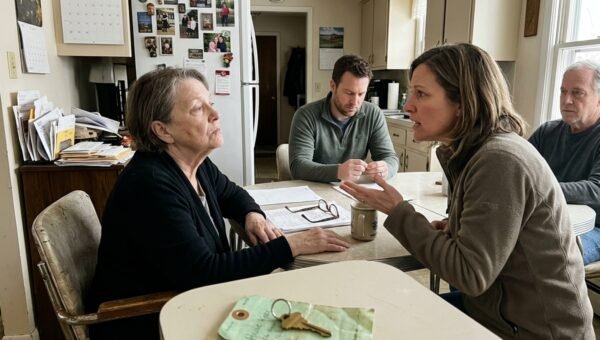
Maren came by after closing. I had the reservation book open on my kitchen table, with a stack of prepaid envelopes beside it.
“You’re making this harder,” she said.
“I’m making sure we don’t leave people holding tickets to a place that’s gone.”
She looked down at the envelopes. “If you push him too far, he’ll walk. Then I’m left with the loan and a business that keeps taking money.”
“I know.”
She put the buyer’s envelope on the table. “There’s one thing you didn’t read.”
I turned to the final page. Near the bottom, beneath the purchase price, was a paragraph with Maren’s name in it. She reached across the table and laid her hand over the first line before I could read what the buyer had promised her.
It was nearly eleven. I was tired, and she looked worse, but I didn’t want another day of making decisions around a page I hadn’t read. I touched her wrist.
“Please move your hand.”
“Mom.”
“I’m not going to read your bank account. I need to know what I’m being asked to sign.”
She pulled back her fingers, slowly. I read the clause once. Then I read it again, because I had gotten one word wrong the first time.
Greg Vance, the developer, would pay Maren’s remaining $42,000 home loan directly at closing. It was listed as a private debt settlement. But it only happened if she got my signature within 48 hours and the property was handed over empty by September 15. The staff had to be let go. Every booking and other obligation had to be cleared. No severance. No refunds.
The clock was built into the offer. It was Thursday night, and the deadline was Saturday morning.
Maren sat down hard in the chair. “I didn’t want you to see that part.”
“What part did you want me to see?”
“The loan paid off.”
“Not the conditions?”
She rubbed a thumb along the paper cup. It had left a coffee ring on my table. “I was ashamed.”
I didn’t say anything for a moment. I could hear the refrigerator kick on. I remember the sound because I didn’t know what else to do with my face.
She said she’d been paying the loan every month since Cal died. The money had first gone toward his care and then toward what was left after the bank refinanced her house. She’d kept up while working fewer hours, while our course barely made enough to get through winter, and while helping me with taxes.
“I thought I could keep up,” she said. “Then I couldn’t.”
“Why didn’t you tell me?”
“Because you’d tell me not to worry.”
“I might’ve.”
“You would’ve.”
She was right. I’d spent years telling her the course was doing fine because I wanted her to have one less thing to carry. It was a pretty poor way to ask for help.
“I didn’t want to lose my house,” she said. “The bank sent another notice. I thought this was the only way to stop it.”
I looked back at the clause. It was not a gift. It was a bargain with everybody else’s job and the course’s life attached to it. Maren wasn’t greedy. She was scared, and she’d convinced herself that the cleanest way out was to make sure nobody got a chance to say no.
I could understand that. I still couldn’t sign.
“I’m not letting Greg make your loan a secret price on the course,” I said.
She looked down. “I didn’t ask you to save the course.”
“No. You asked me to stand beside you.”
“And you won’t.”
“I will. Just not by telling Mr. Alvarez he’s out before we know there’s no other way.”
She went home before midnight. I stayed at the table with the offer, the booking envelopes, and the old reservation book. I slept about three hours. At 5:40 Friday morning, I drove to Starboard Putt.
Mr. Alvarez was already there. He brought coffee in a thermos and a county plat map rolled up inside a grocery bag. The coffee smelled burnt, the same way it always did when he made it too early.
“I figured you’d want the books,” he said.
“I do.”
He had also brought the property records. I’d asked for the reservation book, not the plat map, but Mr. Alvarez has a way of keeping papers that other people throw away. His wife used to do the books, and he’d learned not to trust anyone’s memory when a county record was available.
We went through the bookings first. There were deposits for birthday parties, two school outings, a church group, and a fall league that had already paid for several nights. Nothing that would make us rich. Enough that canceling all of it without a word would leave people feeling cheated.
“Mr. Alvarez, if we close, what happens to your insurance?”
He set his mug down. “I’ll have to figure it out.”
“I’m sorry.”
“Don’t apologize before anything’s decided.”
That stung a little. He had every right to be worried, and I had been treating his job like a detail in a family decision.
We spread the plat map across the counter. The golf holes occupied 1.6 acres, according to the survey. The deed covered more than that. Behind the lighthouse and hole eighteen was a half-acre access strip, unpaved and mostly empty, running along the road toward the neighboring marina.
I knew Cal had bought a narrow piece of land from the old boat ramp authority. I did not know it was a separate parcel. He’d called it “the back lane” and used it to get lumber and old dock boards onto the property. After the course opened, we kept it clear because deliveries needed room to turn around. It never seemed like anything worth talking about.
Mr. Alvarez traced the boundary with one thick finger. “This strip isn’t part of the course.”
“It’s on our deed.”
“Sure is. But it doesn’t have to go with the greens.”
I checked the legal description twice. The line was right there, separate from the course parcel. It didn’t erase our bills or turn the business into a gold mine. It did give us something Greg hadn’t mentioned.
I called Pete Keller at Keller’s Bait & Marina. He’d been next door long enough to know which part of the lake road flooded first and which boat trailers were always in the wrong place. I’d seen him try to turn a trailer around in that narrow spot for years.
“Pete, do you still want the rear access strip?”
There was a pause. “Is it actually for sale?”
“I’m asking what you’d pay.”
He said he’d been trying to buy it for three years. He wanted somewhere to park boat trailers without blocking his customers or the road. He could pay cash if the boundaries checked out.
“How much cash?” I asked.
“Sixty-five thousand.”
I wrote the amount on the back of a reservation envelope. $65,000. Maren owed $42,000. We had property taxes to catch up and repairs to make, but the numbers were close enough that I stopped looking for the catch.
“Can you put it in writing today?”
“I can have my attorney draw up an agreement.”
“Today, Pete.”
“I’ll come over with it.”
I didn’t tell myself we were saved. I’d been around long enough to know an offer and a signed sale weren’t the same thing. But for the first time since Maren handed me that envelope, I had a choice that wasn’t just yes or no.
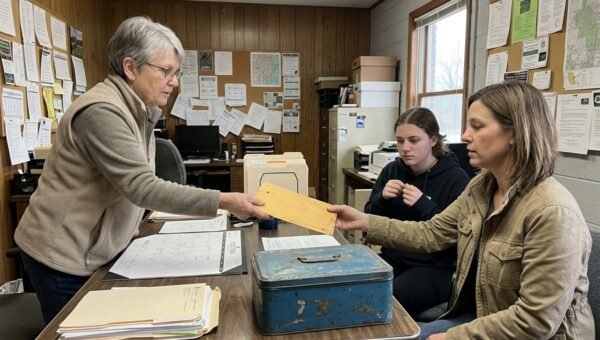
At 10:30, Pete came into the office with a short purchase agreement. He’d checked the parcel description with his attorney and was ready to buy the half-acre for $65,000, subject to the subdivision paperwork. I read every line. Then I read it again. He signed first, and I signed for the property owners.
Maren came in while I was making copies. I’d asked her to meet me, but I hadn’t told her the amount over the phone. She saw Pete’s name on the agreement and stopped.
“What’s that?”
“An offer from Pete for the back access strip.”
She looked from the document to me. “How much?”
“Sixty-five thousand.”
She sat down. I could see the calculation happen. The home loan. The taxes. The remaining bit.
“I didn’t know that land was separate,” she said.
“Neither did I, not really. Mr. Alvarez brought the plat map.”
She read the agreement carefully. She didn’t smile. She didn’t cry. She held one edge of the page and kept pressing her thumb into it.
“That pays off the loan,” she said.
“It should. The bank will send the payoff amount, and the sale can go straight through closing.”
“And taxes?”
“Some left over. We’ll keep a reserve.”
She looked at the reservation book. “We’d still have the course?”
“We’d still have the course.”
She pressed her lips together. “I thought I was doing what I had to.”
“I know.”
“I was going to let them fire Mr. Alvarez with nothing.”
“You were trying to keep your house.”
“I knew what the contract said.”
That was the part I couldn’t smooth over for her. I sat beside her rather than across the desk.
“You hid it because you were ashamed,” I said. “That doesn’t make it all right. But I know why you did it.”
“I should’ve told you.”
“Yes.”
“I should’ve told you about the taxes, too.”
“Yes.”
She gave me a small, tired look. “You’re not going to make this easy for me, are you?”
“No. But you don’t have to do it alone anymore.”
We called Greg Vance’s office. He agreed to meet us that afternoon, though his assistant said the offer had a deadline and he expected an answer. I brought the deed, Pete’s agreement, the map, and the original contract. Maren came with me.
Greg was in the golf shack office with a leather folder open on the desk. He looked past the papers toward the course.
“I thought we had a clear path,” he said.
“You had a path to all the land,” I said. “You don’t have my signature.”
He turned to Maren. “The debt payoff was a good-faith offer.”
“I know,” she said.
“It lets you walk away clear.”
“It lets me walk away clear if we cut everyone loose and clear every booking in a few weeks.”
Greg spread his hands. “That’s how commercial purchases work. I can’t carry your operating obligations.”
“You’re asking us to do that without severance or refunds,” I said. “That isn’t a small detail.”
“I’m paying for the property.”
“You’re paying for both parcels because you want all of it. We’re not selling the course.”
He leaned back. “This is a time-sensitive offer. The numbers may not hold if you delay.”
I didn’t like the way he said it. Not because I thought he was a monster. He had a business to run and storage units he wanted to build. He’d found a way to make a fast sale attractive to Maren, and he was trying to keep it moving. But a clock didn’t make the deal fair.
Maren placed the site plan on the desk. “Did you know the rear strip was a separate parcel?”
Greg looked at it. “It’s part of the property.”
“That’s not what she asked,” I said.
He didn’t answer right away. Then he said, “The parcel can be subdivided. It’s not relevant to my offer.”
“It is to ours,” I said. “Pete Keller has offered $65,000 for the access strip. We’ll use the proceeds to pay the bank directly. The rest of the course stays with us.”
Greg glanced at the agreement. “That doesn’t give you the same certainty as a full sale.”
“It gives Maren her debt paid without making Mr. Alvarez and the kids lose their jobs.”
He looked at Maren again. “You’re willing to give up the payoff clause?”
She put both hands on the desk. “I’m willing to sell the piece we don’t need. I’m not signing away Dad’s course because I’m scared.”
It was the first time she’d said Dad in that office. Her voice caught slightly, but she kept going.
“The full-property offer is no,” I said. “You can make an offer on the road-front parcel if you want, but the course isn’t part of it.”
Greg shut his folder. “I’ll need to talk to my lawyer.”
“Of course.”
He did. His lawyer checked the plat and Pete’s offer. Greg wasn’t happy to lose the full acreage, and he didn’t pretend otherwise. By the end of the meeting, he had withdrawn the full purchase agreement. He made a lower offer on the raw frontage, but we didn’t need it. Pete’s agreement was already moving, and I wasn’t going to sell more land just because the first offer came with a deadline.
Maren drove back with me. Neither of us spoke much. At the first stop sign, she said, “I really thought you’d sign.”
“I know.”
“I thought you’d understand.”
“I do understand. That’s why I didn’t want to pretend the contract was harmless.”
She looked out the window. “I’m sorry.”
“I’m sorry I didn’t see how bad things were.”
That was true, though it wasn’t the same as saying I’d caused it. We both had a habit of leaving money conversations until they were too uncomfortable to have.
The rear parcel sale took a few weeks to finish. Pete’s attorney completed the subdivision, and the bank sent the payoff figure. At closing, $42,000 went straight to Maren’s lender. The remaining $23,000 went into an account for property taxes and course repairs. Maren’s house was safe. We kept the course.
Mr. Alvarez kept his job and his health allowance. The six teenagers kept their summer shifts. We honored the school outings, the birthday parties, and the fall league. The staff meeting we’d nearly held to announce the closure became a planning meeting for the Labor Day tournament and winterizing the pumps.
Mr. Alvarez stood at the counter while Maren told everyone. “We’re open through the end of the season,” she said. “And we’ll be back in spring.”
One of the teenagers asked, “For real?”
“For real,” I said.
Mr. Alvarez looked at Maren. “You sure?”
She nodded. “I’m sure.”
After the staff left, Maren and I sat at the office desk and made a new bookkeeping sheet. We agreed to review the bills together every month. No quiet payments. No pretending. It was less dramatic than a promise, and probably more useful.
She still owed me an apology for hiding the clause. I still owed her an apology for accepting “we’re fine” because it was easier than asking another question. We didn’t settle every old feeling that afternoon. We did start telling each other the numbers.
At the end of the season, I took a faded green golf ball from the jar by the register and walked to the eighth hole. The carpet in the snack shack was still older than Maren, the lighthouse still leaned, and the cup Cal made from boat-ramp timber still gave that soft hollow clunk when a ball dropped in.
I let the ball go. It hit the edge once, then fell through with the same old sound.
Maren locked the shack register and came to stand beside me under the crooked lighthouse beam. I didn’t tell her everything was fixed. It wasn’t. But she was there, the course was still ours, and the ball had gone in.