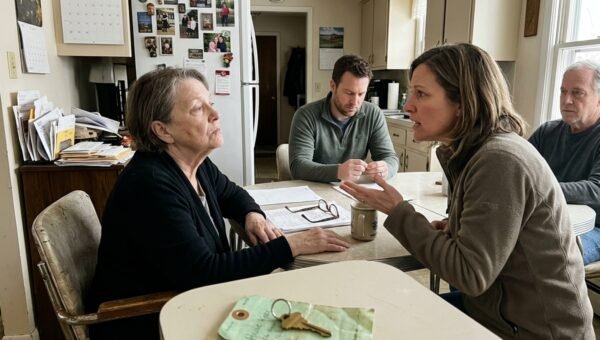

I was pouring coffee into Lydia’s chipped blue mug when the kitchen timer started buzzing. I’d just turned it off when she came in with Ruth’s red shawl folded over one arm and a narrow strip of yellowed paper in her hand. The house was still quiet, and I thought we had a few minutes before the family arrived.
Lydia touched the fringe of the shawl. Then she looked at the paper. “I found this sewn into the lining,” she said. “It’s Mom’s handwriting.”
I knew what was coming before she asked me. I’d carried the answer for twelve years, though I’d never said it out loud in front of her.
I’m June. I’m sixty-eight, and Martin is my husband. Ruth was his mother. Lydia is his sister. I was there the night Ruth died, and I’ve spent a long time telling myself that not correcting Martin was kindness. It was easier than looking at what my silence had done.
Lydia turned the strip between her fingers. Martin came in from the parlor carrying a dish of rolls. He saw the paper and stopped. I set the coffee pot down too hard, and some spilled over the rim.
“You knew Mom left this?” Lydia asked him.
“No,” Martin said.
Then Lydia looked at me. “You were there that night. Did he come in before she died?”
The timer gave one last little click as it cooled. Martin didn’t look at Lydia.
He looked at me, and I could see how scared he still was of being the son who let Ruth down.
“He was in the hospital,” I said. “But he wasn’t in the room when she died.”
Lydia’s fingers closed around the paper. Martin sat down without taking off his coat. He looked older than he had when I’d poured the coffee.
Twelve years earlier, Ruth had had a stroke. It happened fast. By that evening she was in a hospital bed, unable to speak clearly, and Lydia and Martin had already managed to have the argument they’d both been dreading.
Lydia thought Ruth needed a nursing home if she came through it. She’d been handling the appointments and the medicines and the calls. She knew how hard it had become to keep Ruth safe at home. Martin said Ruth could come back once she was stronger.
He didn’t have a plan for how that would work. He just couldn’t stand hearing the word nursing home.
“You can’t keep saying you’ll help later,” Lydia told him that morning.
“I said she can come home.”
“And I said I can’t do this alone.”
Martin had always thought Lydia was better at the hard parts. She could make a decision, keep a list, talk to a doctor without apologizing for taking up time. He loved her for it, and resented her for it too. At least, that’s how I understood it. He often called her bossy when what he really meant was that she’d done the thing he hadn’t.
They didn’t make up before Ruth got worse. Lydia stayed beside the bed that night. Martin was at home when I called him. I told him the nurse had said he should come.
He did. But when the nurse opened the room door, Martin stayed in the hall.
“I can’t go in while she thinks I’m trying to send her away,” he whispered.
I told him Ruth might not have much time. He looked through the narrow glass window in the door, then sat down with his head in his hands.
The clock on the vending machine across the hall changed one minute at a time. I remember the faint lemon smell from the floor cleaner. I don’t know why that stuck with me.
I also remember Martin rubbing his thumbs together, over and over. He’d done that as a boy when Ruth was mad at him. Even then, he was a grown man with gray in his hair, but he looked like a kid waiting to be told he’d failed.
Lydia left the room for a few minutes to call her daughter. There was a payphone down the hall, in a quiet spot near the elevators. She didn’t want to take the call beside Ruth. She’d been there for hours and needed to hear her daughter’s voice.
I stayed near the door with Martin. He kept looking through the glass. He didn’t go in.
A nurse named Evelyn Cole was caring for Ruth that night. I remember her because she had a way of tucking loose sheets in without waking anyone. She was kind to Lydia, and kind to Martin too, though he barely spoke.
While Lydia was on the phone, Ruth woke for a short time. I didn’t see it happen. I only learned about it years later. But I know she could see the hall through the little window in the door, and Martin was sitting right there.
By dawn, Ruth was gone. A nurse came out and told us. Lydia left the room crying, and Martin went in after she did. He stayed a few minutes. When he came out, his face was drawn and his hands were shaking.
He told Lydia he’d been holding Ruth’s hand when she passed.
Lydia clung to him. She’d stepped out to call her daughter, and the thought that Ruth had died alone had been eating at her. Martin’s words gave her a way to believe someone had stayed. I saw her grip his sleeve and press her face against his shoulder.
I could have told her. I didn’t.
At the time, I told myself it was a small lie that helped two grieving people get through the day. Martin had believed for years that Ruth thought he didn’t visit enough. Lydia had carried most of Ruth’s care. They’d fought that morning, and now neither of them had to keep fighting.
That was what I told myself.
The lie lasted because Lydia thanked him for it. Martin accepted the thanks. At Ruth’s birthday dinner, years later, Lydia told the grandchildren their uncle was the brave one who stayed until the end. Martin smiled, though he didn’t say much. I kept cutting the cake.
I was part of it. I let the story settle into the family because correcting it would have hurt Martin, and I didn’t want to be the person who took away Lydia’s comfort. I also didn’t want to have the conversation. That part matters.
After a while, the truth felt harder to say than the lie. It was like missing a shift and hoping no one would ask where you’d been. Each day you don’t explain makes the next day worse.
Yesterday, Martin asked me to help him keep the story going. Lydia was hosting a small memorial at her house. She’d found Ruth’s shawl in a cedar chest and planned to lay it over the rocking chair where Ruth used to sit.
“She’s asked me three times if I remember the last words Mom said,” Martin told me. “Just tell her I was there. Don’t make her relive it.”
“You weren’t in the room,” I said.
He looked down at his hands. “I was there in the building.”
“That isn’t what you told her.”
“I know.” His jaw tightened. “I couldn’t bear to have her think I let Mom die angry with me.”
I believed him. That was the trouble. He wasn’t trying to hurt Lydia. He was trying to get free of a shame he’d made worse by hiding from it. But Lydia had thanked him for twelve years. She’d believed he’d done the thing she couldn’t do.
I didn’t promise Martin anything. I folded the shawl over my arm and went to the memorial.
Now we were in Lydia’s kitchen, with the rolls cooling on the counter and the coffee I’d spilled sitting in a small brown ring on the table. Lydia was holding the paper. Martin was still in his coat.
“If Mom knew he was outside, why did she write that she was waiting for him?” Lydia asked.
I looked at the note. I didn’t know the full answer yet, but I did know the truth about Martin. “I don’t know what else she wrote,” I said. “But I’ll tell you what I remember.”
Lydia took a breath. “Read it.”
Her hands shook, so she passed the strip to me. The writing was hard to make out at first, the letters leaning and uneven. Then I saw the name. Ruth always called Martin “Marty” when she was trying to soften a fight.
I read the words aloud, slowly.
“Tell Marty I see him outside. I am waiting for him to come in. Tell him I’m not angry, I understand.”
Nobody said anything. The afternoon light touched the paper in my hand. Martin reached for the table, missed the edge, then found it with his palm.
I read it again, because I couldn’t think of anything else to do. The line about not being angry sat there between us. Martin had spent twelve years believing he’d failed the one person whose approval he still wanted. Ruth had seen him in the hallway and had been trying to reach him.
Lydia sat down. “She saw him?”
I nodded. “The door had that narrow glass panel. She must’ve seen him sitting there while you were on the phone.”
Martin shut his eyes. I watched his fingers press into the table.
The next part came back in pieces. Not because I’d been there for all of it, but because Evelyn had told me what happened after. Ruth had asked for paper and a pen while she was awake enough to understand where she was. Evelyn found a scrap of chart paper and gave it to her.
Ruth could only write a few lines. She knew Martin was outside. She knew about the argument. Somehow, even then, she knew he was too ashamed to walk through the door.
Evelyn folded the note and meant to give it to Martin. After Ruth died, the hospital room was busy. Lydia was crying. Martin had gone in. I was trying to keep track of coats and bags and who needed a ride. Evelyn tucked the paper into the pocket of Ruth’s red shawl, then fastened it in the lining so it wouldn’t fall out.
She didn’t get a chance to hand it over. We left the hospital without knowing it was there.
“She was trying to tell him she wasn’t angry,” I said. “She was trying to help him come in.”
Martin started crying then. Not loudly. He covered his face with both hands, and his shoulders moved once, then again. He didn’t look like the brave one Lydia had praised. He looked like a man who had been carrying an old fear so long that he’d forgotten it was possible to put it down.
“I was scared,” he said. “I thought she’d look at me and know I’d let her down.”
Lydia was watching him. She still had tears on her face, but her voice was steady. “So you let me think you were in there.”
Martin lowered his hands. “Yes.”
“You let me thank you.”
“Yes.”
“You let me feel guilty for leaving.”
He looked down. “I’m sorry.”
That was when I understood the hurt in Lydia’s face wasn’t only about the lie. It was about the years she’d spent telling herself she’d failed Ruth in those few minutes away from the room. Martin had known what she feared. He’d accepted her gratitude anyway.
“I should’ve told you,” I said. “I knew, and I stayed quiet.”
Lydia turned to me. “Why?”
“I thought I was protecting both of you. I was wrong. And honestly, I didn’t want a fight with Martin.”
That wasn’t a pretty answer. It was the true one.
Lydia pressed the note flat on the table. For a moment, I thought she might tear it. Instead, she held it out to Martin.
He didn’t take it at first.
“Read it,” she said.
He leaned forward and read the words in Ruth’s handwriting. He got to “Marty” and stopped. That was his name in her voice, the name she used when she wanted him to come sit by her at the kitchen table. He read the rest without speaking.
Then he took the paper. His thumb rested beside the words “I understand.”
“She knew,” he said.
Lydia wiped her cheeks with the heel of her hand. “She knew you were there.”
He nodded. “I still couldn’t go in.”
“I know.”
“I thought you were the strong one,” he said.
Lydia let out a short breath. “I was just the one who stayed in the room.”
We didn’t fix twelve years in one kitchen. Lydia was still angry. Martin was still ashamed. I was still the person who had helped keep the lie alive. But the note changed what they were looking at. Ruth hadn’t left Martin a judgment. She’d left him a way in.
The family started arriving before anyone had put the rolls out. I heard coats being hung in the front hall and someone asking where to put a dish. Martin stood up, took off his coat, and asked Lydia if she wanted to speak about Ruth.
“You should,” she said.
“I don’t want to pretend I was in the room.”
“Then don’t.”
That was all they said. But Martin stayed beside her as the others came in. He didn’t tell the old story. When an aunt mentioned how brave he’d been, he looked at Lydia, then said, “I wasn’t in the room when Mom died. Lydia was there with her. I should’ve said that years ago.”
The aunt didn’t know what to say. Neither did I. Lydia reached over and touched Martin’s arm. She didn’t tell him it was all right. I was glad she didn’t have to.
Later, Lydia spoke about the calls she’d made, the lists she kept, and Ruth’s habit of asking for tea after she’d already had a cup. She didn’t make herself sound like a saint. She said she’d been tired and impatient sometimes. Martin stood beside her and listened without taking the story away from her.
When she finished, he told one small thing about their mother, how Ruth used to save the broken cookies for him because he liked the pieces best. People laughed a little. Lydia did too, though she was crying.
I took the shawl into the parlor. The rocking chair was empty, the way we’d planned. I laid the red wool across its back, then placed Ruth’s folded note on the seat beneath it. I didn’t tuck it away this time.
The afternoon light reached the paper. “Tell Marty I see him outside,” Ruth had written. Martin stood in the doorway, beside his sister. Neither of them was alone with the story now.