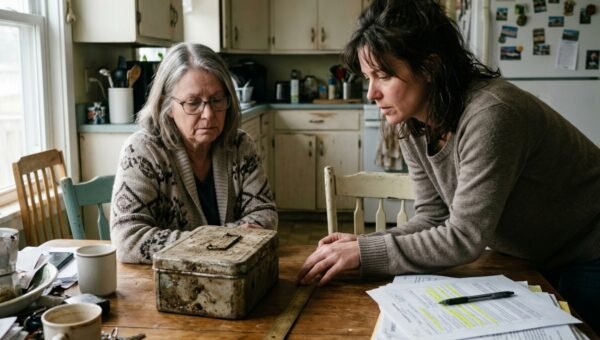

I had six pages spread across the conference table, and I was halfway through telling my daughter’s staff the newsroom wasn’t part of the deal when Greg Vance walked in with another envelope.
The first offer was still open in front of me. Page six sat on top. I’d marked one sentence with my red pencil, the way I used to when a line looked clean but meant something else. Mara stood near the door with two coffees, still wearing her coat.
She’d asked me to stand beside her and tell everyone the newspaper was safe. The offer said the newsroom would close in thirty days.
Greg placed the new envelope on the table. “There’s one change you need to see before you vote.”
Mara looked at me. I could tell she hadn’t seen it either. I picked up the envelope, but Greg put a hand on it first and said he’d explain the addendum privately. There were twelve people in that room. I didn’t see any reason the explanation should be private.
I’m Ruth, sixty-six, retired proofreader, and I own fifty-two percent of the paper. My father bought the weekly with money from selling his fishing boat. He used to say I could tell when a sentence was trying to hide something. Mara got the publisher’s job because she could bring a room around to believing there was still a way forward.
For a long time, I thought those were two different kinds of talent. On Monday morning, I found out how much it mattered that they weren’t.
I broke the seal.
But to explain why I didn’t hand the envelope back to Greg, I need to go back to Friday night, when Mara called after dinner.
The paper had been in trouble for a year. Local ads moved online, the print bill went up, and two reporters left for jobs with steadier checks. Mara started covering school board meetings herself, sometimes filing stories after midnight. I knew all that. I didn’t know she’d used her savings to cover bills or that she’d signed her name to the line of credit.
The call came while I was rinsing a plate. I remember the dish towel had a little snag by the hem. That’s not important, except I remember thinking my hands needed something ordinary to do while she talked.
“A regional printing company made an offer,” she said. “They’ll pay the back payroll and keep the paper’s name alive.”
“Everybody keeps their jobs?”
There was a pause. Not a long one. Just long enough.
“The offer is complicated,” she said. “I need you to help me get through Monday before people panic.”
I should have asked her to send me the offer right then. Instead, I said I’d come in. I wanted to help my daughter, and I wanted to believe those could be the same thing.
On Saturday, I went to the office looking for a page Mara wanted me to review. I found an envelope in the copier tray with her name on it and the buyer’s name printed across the front. I told myself I wasn’t snooping. I was still telling myself that later, when I read the last page three times.
The first five pages talked about preserving the paper’s community identity and honoring the archives.
The sixth listed what Apex Print Group would actually buy: the presses, the subscription database, and the building’s lease. The offer specifically excluded the newsroom staff and any obligation to publish local reporting.
I took a photo of the page and put the papers back where I found them. The copier made a short grinding sound when it woke up. I remember that too. My father used to complain that a machine always picked the worst time to jam, though in his day the problem was a press roller, not a copier.
Mara came in carrying two coffees. I didn’t ask why she had brought one for me. She saw the papers and stopped.
“You saw it,” she said.
“I saw what you want me to stand beside.”
She set my coffee down without taking off her coat. “If I don’t accept, payroll bounces Friday. I’ve been paying the print bill from a line of credit. I can’t keep doing it.”
“Then tell the staff the truth.”
“And watch them leave before we can make a deal? Mom, I’m trying to buy them time.”
I could see that she was tired. Not the ordinary kind after a long week. The kind where a person has been doing the same impossible math every night and hoping the numbers change if they stay up later. That didn’t make the lie right. It did make it harder to call her a liar and leave it there.
Callie, our photo editor, had turned down a job in another town because Mara told her the paper would stay local. I knew because Callie had mentioned it to me in the hall a week earlier, smiling as she talked about her new apartment. Mara knew too. The buyer’s offer had arrived after that. I don’t know exactly what Mara told herself in the days between. I know she’d been trying to keep the staff in their chairs until she could find a way to pay them.
That evening, I asked her to come to my house. She didn’t. She showed up at the office with a statement for me to sign.
It said Apex had committed to continuing local coverage and retaining current staff.
“Where did you get that?” I asked.
“From what they told me.”
“Not from what they put in writing.”
She took the page back. Her fingers bent one corner.
“You can make this sound like I’m stealing from them,” she said. “I’m trying to keep the lights on.”
I pulled the articles of incorporation from the filing cabinet. My shares gave me the right to block an asset sale, but they didn’t give me money to run the paper. If I stopped the deal, the bank could call the credit line. The presses could go to auction, and everybody could lose their jobs without getting the wages they were owed.
That was the part I couldn’t fix by being right.
I called Greg Vance, the Apex representative, and asked to meet before the staff gathered Monday. He wouldn’t talk terms without Mara. I called the bank after that. The loan officer said we had until Thursday to present a plan if I withheld approval. Not Friday. Thursday. I wrote it down in my father’s old leather ledger beside the dates he used to mark each issue.
At six, I sat with Mara in the dark newsroom. A school calendar hung crooked on the wall. There was a half-finished story about the high school gym roof leaking again. I’d seen that story come around every winter since I stopped proofreading. The roof still leaked.
“You can stop the sale,” Mara said. “But you can’t make me publisher again afterward.”
“I’m not trying to.”
“I’m tired of being the person who tells people bad news.”
“I know.”
She looked at the ledger in my hands. “If you show them that last page, they’ll know I let them hope.”
I told her I’d show them what the offer said. I told her I’d ask Apex for a new deal that protected the reporters, even if it meant giving up the building. I didn’t promise it would work. She stood and put a hand on the back of my chair before she left.
On Monday, I got to the office early. The staff meeting was set for nine. I could hear the coffee maker burbling in the break room, and I could smell the burnt edge of the first pot. Callie had a notebook open at her place. Jim, our press operator, sat with both hands around a paper cup. He’d worked for my father before I took over proofreading, and he still called the old printing room “the shop.”
Mara came in with the two coffees. She didn’t look at the pages on the table. Her mouth was set the way it got when she was trying to hold all the pieces together by herself.
She started to speak. I put my hand on the offer.
I told the room the sale did not include the newsroom. I said the offer named the presses, database, and lease. I was about to read the last sentence aloud when Greg walked in with the second envelope.
The paper on it said “Executive Transition Addendum.” Under that, in smaller print, were the words “Confidential Shareholder Terms.” Greg asked me to step outside with him. I said no.
The staff didn’t move. Mara’s coffee cup made a little ring on the table.
I opened the envelope and took out two pages. I read the first paragraph, then the clause that mattered.
Apex would pay me $40,000 as an “archival consulting stipend.” The company would also assume Mara’s personal co-signed line of credit. In return, I had to vote for the immediate firing of every newsroom employee, close local reporting, and sign an absolute non-disparagement agreement.
I read it all. Slowly enough that nobody could say they hadn’t heard.
Jim’s cup made a small crackling sound in his hands. Callie looked from the page to Mara.
Greg leaned back. “That’s a standard transition arrangement.”
“It says you’re paying me to approve closing the newsroom.”
“It compensates you for your time and the archives. The company is taking on significant obligations.”
“Which obligations include firing these people?”
He looked at Mara. “The new publication would be an advertising circular. The current reporting model isn’t sustainable.”
Mara hadn’t known about the payment. I saw that before she said anything. Her face changed, and she put down the coffee she’d been holding.
Greg had called my office Saturday afternoon. I’d told him I needed the complete terms in writing. I hadn’t told Mara because I didn’t want her to think I was negotiating behind her back. I also hadn’t expected him to turn my question into a private offer. That was on me. I’d been too careful about not upsetting her and not careful enough about what he might do with the opening.
Callie closed her notebook. “You told me the jobs were part of the offer.”
Mara swallowed. “I thought they might be.”
“You knew I turned down the other job.”
“I know.”
“Did you know this was in there?”
“No,” Mara said. “I didn’t.”
Callie kept looking at her. “But you knew about page six.”
Mara’s eyes dropped to the table.
“Yes,” she said. “I knew.”
Nobody said anything for a few seconds. I could hear the coffee maker click off in the break room. I wanted to reach over and touch my daughter’s arm. I didn’t. She needed to own what she had done in front of the people she’d asked to trust her.
“I was scared,” she said. “I thought if I got through Monday, I could find another way. I’m behind on my apartment. I put my savings into this. I let all of you think the jobs were safe because I didn’t know how to say they weren’t.”
Callie’s eyes were wet, but she didn’t cry. “I turned down that job because you told me this place would stay local.”
“I know. I’m sorry. I’m sorry, Callie.”
Mara looked around the table. She didn’t make excuses after that. She told them she had co-signed the credit line and that the bank deadline was Thursday. I hadn’t known her apartment was two months behind until then. She said the money in the addendum was news to her. She also said she should have told them the truth as soon as she saw the first offer.
I was proud of her for saying it. I was angry she’d waited. Both things were true.
Then I closed the addendum and laid it on top of page six.
I told the room I had fifty-two percent of the voting shares. My father left them to me because he trusted my judgment, not because he expected me to rescue the paper from every bad year. I said the bank would give us until Thursday to bring forward a plan. I also told them the presses and building lease might have enough value to cover the debt and back wages, though I hadn’t yet got a firm number.
“You’re offering to sell the building?” Jim asked.
“I’m offering the parts Apex wants.”
“And the paper?” Callie said.
“The name, the archives, the subscriber list, and the reporting stay with us.”
Greg tapped the addendum with one finger. “The database is part of the package.”
“Not in my counteroffer.”
He gave a short laugh. “You don’t have a printer, a building, or a way to cover payroll.”
“I have a press company that needs a press and a building. You told me so in the first offer.”
He didn’t answer. I had read the contract closely enough to know Apex wanted the old German offset press and the downtown lease. They could move their regional printing work into our space. The subscription list would be useful to them too, but they couldn’t buy what I didn’t approve selling.
I laid out what I could offer: the press machinery and the remaining lease rights, at fair value. The money would pay the bank and the staff’s back wages. The paper would keep its masthead, archives, subscriber list, and reporting rights. We’d move into a smaller shared space and use contract printing for the community insert while shifting the weekly edition online.
Greg said Apex wasn’t in the business of funding a newsroom.
“I’m not asking you to,” I said. “I’m selling you the equipment you need. You can take it, or the bank can auction it.”
That wasn’t a threat I enjoyed making. If the bank auctioned the presses, we might get less for them. We could also lose the lease before we found another place. I didn’t say that part aloud. Greg knew it already.
Mara stood up.
“I’m voting no on the full sale,” she said. “And I’m not asking anyone here to keep trusting me just because I’m sorry. I’ll do the work to earn it back.”
It was the first time that morning she sounded like the publisher.
Greg asked to see the bank deadline and the share documents. I slid the ledger and incorporation papers across the table. He read them, then stepped into the hall to call his office. We waited. Nobody picked up their coffee. Callie rubbed the edge of her notebook with her thumb. Jim looked at the old press room door.
Greg came back after ten minutes. He said Apex would accept the equipment and lease transfer if the valuation held and the paper’s name and archive were excluded. He wanted the paperwork finished before Thursday.
I said we would have our lawyer look at it. He said that was fine. The first offer was off the table, and so was the addendum. I watched him tuck the papers into his folder. He didn’t apologize. I didn’t expect him to.
The next two days were forms, calls, and numbers. We got an independent valuation for the press equipment and lease rights. The bank reviewed the draft and agreed that the sale proceeds would cover the credit line and overdue payroll. It was close enough that I checked every figure twice, then asked someone else to check them too.
Mara called the staff together Tuesday afternoon. She told them what she had told us Monday, without polishing it. She apologized to Callie again. Callie said she wasn’t ready to say everything was fine, but she’d stay through the transition.
“I can work with the truth,” she said. “I can’t work with guesses dressed up as promises.”
That line stayed with me. It was the kind of thing I might have marked in a draft, except there was nothing to fix.
On Thursday, the sale papers were signed. Apex took the heavy presses and the building lease. The bank note was paid, and the staff got their back wages. Nobody cheered. We’d lost the place where my father started the paper, and the press room was going to be taken apart. Jim stood by the machine for a while after the movers came in. He ran one finger over the edge of the worktable, then put his coat on.
The paper kept its name, archives, subscriber database, and editorial control. We rented space in a smaller shared office and lined up contract printing for the community insert. The online edition would carry the regular reporting. It wasn’t the old setup. It was also not a glossy advertising circular with no local stories.
Mara and I changed the bylaws before the month was out. I transferred part of my voting shares into an employee trust, with staff and community seats on the board. I didn’t want Mara carrying the whole thing alone again, and I didn’t want my own controlling block to become another private bargain someone could make around the newsroom.
Mara didn’t ask me to take over as publisher. I didn’t offer. We worked out what I could do without pretending I was thirty years younger or she wasn’t exhausted. I’d review copy and sit in on the board meetings. She’d run the paper with the staff instead of trying to be the bank, the publisher, and the whole newsroom at once.
The first few weeks were awkward. There were fewer printed pages, more links, and plenty of questions from readers who still wanted the paper folded under their arm. We put out a small community insert while the online version got settled. Callie stayed. Jim helped us sort the old photo files and gave the staff stories about my father’s first winter with the press.
Mara and I didn’t fix everything in one conversation. I still wished she’d told me sooner. She still hated that I’d called the bank before she knew what I was doing. We talked about both. It was uncomfortable, which I guess was better than pretending there was nothing to talk about.
A few weeks later, Mara came to my kitchen with the galley proof for the next front page. We spread it out beside my father’s ledger. She had brought the paper copy because she knew I still liked to mark it by hand. The new office was crowded, and my kitchen table had enough room.
She’d put both our names under the masthead. I told her I wasn’t sure I needed to be on the front page.
“You’re part of this,” she said.
I didn’t argue. My red proofreader’s pencil was beside the ledger, its paint worn off near the point. I read the last line, checked the name of the town, then marked one small correction. For the first time in weeks, neither of us had to pretend the paper was safe because we’d hidden the danger.
The next week’s front page carried both our names, and the red mark was clean.