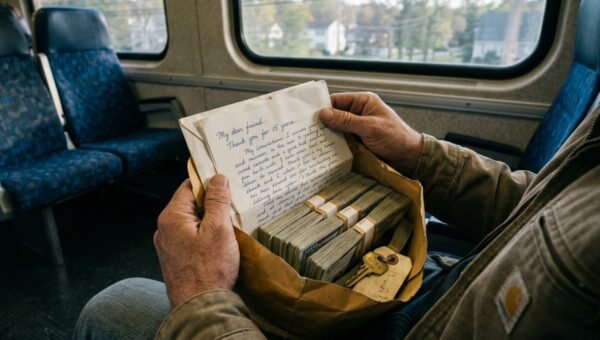
At sunrise, I found an envelope with my name under the doormat, left by the elderly homeless man I’d let sleep on my porch. It had my late father’s handwriting on it. I knew that handwriting before I knew what the envelope held, and my hands started shaking so badly I had to sit down.
The night before, I’d given the man soup, coffee, and a dry blanket while rain hammered the porch roof. He’d told me his name was Thomas, but nothing more.
I didn’t know he’d spent years carrying my father’s last gift to me and my daughter. I didn’t know he’d come to my door to see what kind of person I was.
I only knew he was cold.
I was living in a little rental cottage in a West Virginia town with my seven-year-old daughter, Lily. I was behind on bills, not in some dramatic way where the lights were already off, but enough that I checked my bank app before buying groceries. I’d learned to stretch a bag of rice and make sure Lily didn’t notice when I skipped lunch.
That afternoon, I’d told her we’d have soup for dinner because it was easy and because we had a can of chicken soup left. She’d drawn at the kitchen table while I stirred it. Her crayons were all over the placemat, and she kept asking whether we could put a birdhouse in the yard someday.
“Maybe when we have a yard that stays ours,” I said.
She looked up at me. “This one doesn’t?”
I told her it did for now. I hated that answer, so I got busy with the bowls.
A little after ten, the storm rolled in hard. The power flickered twice. I was checking the front door latch when I saw someone huddled under the porch roof, just beyond the window. He had a backpack beside him and rain running off the sleeves of his coat.
I didn’t open the door right away. I’m not proud of that. I stood there with my hand on the lock, thinking about all the warnings I’d heard growing up and the fact I was alone with Lily. Then the man tried to pull his wet coat tighter around himself, and I could see he was shivering.
I called through the door, “Are you hurt?”
He shook his head. “No, ma’am. Just looking for somewhere dry.”
I opened the door but kept the screen between us. He was older than I’d first thought, with a rough gray beard and a face that looked tired all the way through.
His shoes were soaked. His backpack was faded and sagging, but he held it close like it mattered.
I asked if he had anyone I could call. He said no. I asked if he wanted me to call the shelter. He said he’d rather wait until morning, if I didn’t mind.
That made me feel bad, though I wasn’t sure why. Maybe because he asked so carefully, like he already expected the answer to be no.
“Can you stay on the porch?” I said. “I’ll bring you something.”
“Yes, ma’am. Thank you.”
I carried out a bowl of soup, a mug of coffee, and an old wool blanket. The blanket had a loose blue thread near one corner. I’d been meaning to mend it for months. Thomas took it with both hands and said he’d keep it clean.
“You can come inside if you need the bathroom,” I told him. “I’m just being careful with my daughter.”
“I understand,” he said. “You’re doing right by her.”
I remember that line because he said it like he knew something about me.
But I was tired and worried about the weather, so I didn’t ask what he meant. I shut the door, checked the lock, and left the porch light on.
Lily had seen him through the window. She asked if he was going to be all right.
“He’s got a blanket and something to eat,” I said.
She watched the porch for a while. Then she drew a little house with a roof that covered a very small stick person. I told her it was sweet and got her ready for bed.
I slept badly. The storm kept waking me, and every time I got up, I checked that the front door was locked. I also looked through the window to make sure Thomas was still under the porch roof. He was there the last time I checked, sitting with his back against the wall and the blanket around his shoulders.
I didn’t hear him leave.
In the morning, the rain had stopped. The porch was empty, and the blanket was folded on the chair. I was annoyed for about half a second that he’d gone without saying anything. Then I saw the envelope under the doormat.
My full name was written on it in a neat, square style I hadn’t seen since I was a kid. My father, Arthur Miller, used to write labels on his shop drawers that way. Even the letters looked measured.
I brought it inside and sat at the kitchen table. Lily was still asleep. I didn’t want to open it, but I couldn’t leave it sitting there either. There was an old photograph inside, a letter, several official papers, and a thick stack of savings bonds.
The photograph showed me at twelve, holding a brass sundial my father had made. My hair was in two crooked braids. I could see the scratch across the sundial from when I dropped it on the driveway. I don’t know why I remember that scratch, but I do. My father fixed it and told me not to hide things just because I’d made a mistake.
For years after our fight, I’d wanted him to say something like that to me.
The letter was addressed to me, in the same careful handwriting. I read the first line twice because I couldn’t get my eyes to stay on the page.
“Claire, I was wrong to make pride more important than my daughter.”
I stopped reading. I put the letter down and went to the sink, though there was nothing there to wash. I just stood with my hands under the tap until I realized the water wasn’t even running.
My father and I had been estranged for years before he died. I left town eight years earlier after a fight that started over my choices and turned into every old hurt we’d never dealt with. He was rigid, and I was angry, and we both knew how to make a small argument last for months.
I left home at twenty-six. I went into a relationship that looked steady from the outside and wasn’t. By the time it ended, I had a daughter, debt, and no good reason to go back to the town I’d left. I changed addresses twice and stopped answering calls from people who knew my father.
I told myself I was protecting Lily from old trouble. Some of that was true. Some of it was me being too ashamed to admit I’d made a mess of things.
My father never came to see us. He never called. I heard secondhand that he’d been sick, and I didn’t go to him. I still get caught on that part. I wish I could say I didn’t know how bad it was, but I knew he had cancer. I told myself I’d call when I had the right words. I kept waiting for a version of me who wasn’t mad.
He died five years ago.
The letter said he’d watched from a distance. He knew when I graduated, though he hadn’t been there. He knew Lily’s name. He’d asked a mutual friend how old she was and whether she liked to draw. He wrote that he was sorry he’d let his pride turn silence into a habit.
He didn’t ask me to forgive him. That would’ve been too easy, I think. He just said he hoped the things he’d left would give Lily the kind of safe start I should have had.
The papers made my hands shake again. The bonds were registered in my name and Lily’s. Their total value, with the amounts due, was more than $80,000. There was also an attorney-notarized letter of distribution naming Thomas Vance as the person entrusted with them.
The last paper was a deed to my father’s small craftsman cottage. It was paid off. The deed had been released from the bank, and the property was in my name.
I had no idea whether any of it was real. I wanted it to be, which was exactly why I didn’t trust myself. So I called the county clerk’s office, then drove there after I got Lily settled with a neighbor.
The clerk checked the property record and confirmed the cottage was free of liens. The probate clerk confirmed the papers tied back to my father’s estate. The bonds were real, too. She explained what I’d need to do to redeem them and told me to speak with a financial adviser before moving any of the money.
I asked if the papers could be some kind of mistake.
She looked at the file. “The transfer was done through an attorney. It appears to be in order.”
My father had settled his remaining debts before he died and sold his share of the machine shop. He set aside the bonds, the house, and his personal things for us. He’d entrusted it all to Thomas, with instructions not to give it to me until Thomas could find me and make sure I was safe.
That last part bothered me. I didn’t like imagining a stranger deciding whether I deserved my father’s money. But I also understood the care in it. My father had been scared I’d be pulled back into the kind of trouble I’d spent years trying to leave.
I looked at the old photograph again. The man on my porch had known me when I was twelve. He’d known the sundial.
I called the outreach center listed on a card I found tucked into the envelope. St. Jude’s Community Outreach was a small place in town, and Martha Gable, the director, answered the phone. I told her about the man on my porch and gave her his name.
She went quiet for a moment. Then she said, “Thomas Vance?”
I said I thought so.
Martha told me Thomas had been staying at the shelter off and on. He’d lost his wife three years earlier after a long illness, and the medical bills had eaten through what they had. He’d gotten behind on everything after she died. He hadn’t asked much from anyone. He’d been moving between the shelter, bus stations, and a few places where people let him sleep.
“He’s a good man,” she said. “He just doesn’t want to be treated like a problem.”
I asked if he’d told her about my father.
“Not much,” she said. “He said he had a promise to keep.”
The timing made sense in a way I didn’t like. Thomas had been trying to find me for years. He’d finally traced my current name and address a couple weeks earlier, using public records and people who still knew my family. He didn’t want to knock on my door with a fortune in his backpack and ask me to trust him. He wanted to see that I was safe first.
I asked Martha where he might be. She said he sometimes went to the county transit station to catch a bus west when he couldn’t get a bed. I thanked her, put the envelope in my bag, and drove there.
I should have taken a minute to calm down before I went in. I didn’t. My head was full of my father’s letter, the deed, and the thought of Thomas sitting outside in wet shoes while carrying my daughter’s future around.
He was on a bench near the bus bays, backpack at his feet. A westbound bus was getting ready to leave. I called his name, and he looked up.
“Thomas.”
He stood quickly, then seemed to think better of it and sat back down. I held up the photograph and the papers.
“Why did you leave?” I asked. “You were sitting on my porch, and then you were gone.”
He looked at the bus. “I didn’t want to crowd you.”
“You left my father’s letter under the mat.”
“I thought it was better if you had time to read it.”
“You could’ve told me who you were.”
He rubbed one hand over the other. His nails were dark with old grease that no amount of washing seemed to remove. He told me he’d been my father’s closest friend and shop partner for most of their lives. He’d worked beside Arthur for decades. He’d seen me grow up, though I only remembered him in pieces.
He said my father had made him promise to deliver the packet to me when I was settled and safe. Thomas had kept it through his wife’s illness, through the bills, and through the years he slept wherever he could. He said he never touched a dollar.
“Not once,” he said. “It wasn’t mine.”
I asked why he’d come to my porch without telling me any of that.
He said he’d been afraid. He’d watched my father hurt me with his silence, and he didn’t want to add another stranger’s claim to my life. He wanted to know I had a home and that Lily was cared for before he handed over the papers. When he saw her drawing through the window, he said he could tell she was loved.
That made me mad, then made me feel guilty for being mad. I was tired of people deciding what I could handle. But Thomas wasn’t trying to control my life. He was trying not to make the worst day of his own life worse for me.
I looked at his backpack. It was the same one he’d had on my porch. I thought about how he’d kept the envelope dry. I thought about the blanket folded neatly on the chair.
“Why didn’t you come inside?” I asked.
He said he was ashamed of what he’d become. He didn’t want me to see him as a charity case, and he didn’t want to be a burden to my new beginning.
That was the one line that stayed with me. “I didn’t want to be a burden.”
I took his backpack from the bench. He tried to stop me, but I was already holding it. It was heavier than it looked.
“You’re coming with me,” I said.
He looked worried. “Claire, I can’t just, ”
“You can. We’ll figure it out.”
He said he didn’t want to take the house from us. I told him the house had been meant to help us, not make him sleep outside. I wasn’t asking him to hand over anything else. He’d already done what my father asked.
The bus pulled away while we were still talking.
Martha helped us get him an appointment at the outreach clinic, where they started sorting out his care and paperwork. I worked with an attorney and a financial adviser to redeem the bonds properly. Some of that money went to clear the old medical and credit debts I’d been carrying. I put a protected amount aside for Lily’s education so I wouldn’t be tempted to use it for ordinary bills.
The cottage was sturdy, though it needed work. My father’s workshop was still there, with the old tools put away in drawers he’d labeled in that same block lettering. Thomas knew where everything belonged. He helped us move in, then started fixing up the ground-floor room so he could live there without climbing stairs.
It didn’t happen in one tidy afternoon. We had paperwork, repairs, appointments, and more than one hard conversation. I cried in the kitchen the first night because the house was ours and I didn’t know what to do with a future that wasn’t measured in rent due dates.
Thomas didn’t tell me not to cry. He just put the kettle on.
I still don’t know what to call what he did on my porch. He told me he wanted to see if I was safe. I think he also wanted to know whether my father’s trust had been misplaced. That sounds unfair when I say it like that, but it was true. Thomas had carried a promise through years when he could have used the money to save himself. He needed to know it would reach the right hands.
A few months later, the workshop smelled like sawdust and the lemon cleaner I used on the kitchen floor. Thomas sat beside Lily at the bench, showing her how to hold one of Arthur’s old carving tools. He’d found a scrap of wood and was helping her make a bird.
“Not too hard,” he said. “Let the blade do the work.”
Lily leaned closer, careful and serious. I watched from the kitchen door with my hands resting on the frame. They were steady.
On the porch, the old wool blanket was folded over the chair again. The loose blue thread was still there. I’d finally gotten around to mending it.