The text from Mr. Henderson came while I was parked outside Jesse’s rental in Sapulpa.
“Need the place empty by the first,” he wrote. “Let me know when you’ve got the key.”
I read it twice, then looked at the house. The front door was open because I’d been carrying things out. My brother had died the month before, at fifty-nine, and now it was my job to clear out the place where he’d lived alone.
Jesse and I had barely spoken for five years. I’d spent most of that time thinking I’d done something to make him mad.
Now I was standing in the doorway of his nearly empty house with the key in my hand and no chance left to ask him.
I’m his younger brother. We grew up close enough that people called us a pair. Every deer season, we hunted together. Every Sunday after church, we took a booth at the Cracker Barrel and argued about who had ordered the better breakfast.
It wasn’t some big fight that ended that. Jesse just began backing away. He quit calling. At Thanksgiving he’d say he had work or wasn’t feeling well. I’d ask what was wrong, and he’d tell me nothing.
I took him at his word, mostly. Then I’d go home and wonder what I’d said.
The place in Sapulpa was so bare I could see the shape of his life by what wasn’t there. His VFW cap hung by the front door. There were a few shirts, some kitchen things, a chair with a loose arm. A drawer was full of overdue medical bills.
That told me plenty, though I didn’t yet know what it meant.
Took me a broke me how little there was. His whole life fit in the bed of my F-150.
I remember the sound of the aluminum ramps rattling when I slid them back into the truck. I remember that better than I remember what I said while I was working. I kept moving because if I stopped, I had to look at the empty rooms.
Most of the house was unlocked. The bedroom closet had a metal cabinet with a padlock on it. It was the only thing in the whole place he’d locked.
I carried the bolt cutters in from the truck. I stood there with them in my hands long enough to make myself feel foolish. Part of me didn’t want to know. The landlord wanted the place cleared by the first, though, and I couldn’t leave it for whoever came after me.
So I cut the lock.
The metal snapped louder than I expected. I opened the cabinet doors and stood there for a good while just looking.
The first shelf held a hunting log in Jesse’s handwriting. Beneath it was our dad’s old brass compass, still in its worn leather case. There were photographs too, not just loose pictures thrown in a box, but framed ones wrapped in a dish towel.
I picked up the hunting log. The cover had a dark thumbprint near the bottom, probably from oil or dirt. I knew that mark. Jesse used to hold the book while Dad read the notes from the previous season, and he’d get annoyed if Dad skipped a page.
I opened it. Our names were there, along with dates and places. Some of the handwriting was Dad’s. Later pages were Jesse’s.
I sat down on the bedroom floor.
There was a picture from the first year Jesse let me carry the rifle.
I couldn’t have been more than twelve. My coat was too big and my hair was sticking out under a knit cap. Jesse was beside me, grinning like I’d brought home a trophy, even though the picture was taken before we’d seen a deer.
I’d forgotten that picture existed.
There were little things, too. A Cracker Barrel receipt from years ago, folded in half. Then another. Then more, stacked in date order. Some had our breakfast orders written on the back. Jesse had saved them like they mattered.
I know how that sounds. They were receipts. Greasy little slips of paper. Still, I ran my thumb over the fold in one of them and remembered sitting across from him while he stole the last bite of my hash brown.
I looked at the cabinet again. The top shelf was the life I thought we’d shared. The lower shelves had papers arranged in neat folders.
That was when I saw the cardiology forms.
The first page had a date from five years earlier, the same month he stopped calling. I checked it again because I thought I’d read it wrong. I hadn’t.
There were clinic summaries, test results, medication lists, and appointment notes. Some had hospital names at the top. Others were folded bills. I knew enough from the drawer in the kitchen to understand that Jesse hadn’t been keeping up with all of them.
I read every page.
I wish I could say I found one clear note that explained everything. I didn’t. I found the diagnosis, then the follow-up visits, then more tests. His heart was failing. The words were plain. The dates weren’t.
Five years before he died, Jesse had been told his congestive heart failure was severe and wasn’t going to get better.
I had spent those same five years asking myself what I’d done to him.
I found the date of his first appointment and knew exactly what I’d been doing that week. I’d called to ask if he wanted to come over for supper. He said he was busy. A week or two later, he missed my call. By Thanksgiving, he had an excuse ready before I could ask.
I sat with the papers in my lap until the edges started digging into my fingers.
A note on one report said his stamina had gotten worse. Another listed the cost of care and the lack of insurance. I didn’t know how much it cost him. I knew what the unpaid bills looked like, though. I knew he’d kept them in a drawer where I’d find them after he was gone.
I’d thought I was being patient by giving him room. I’d also been offended. I hate admitting that. There were times I told my wife, “If Jesse wants to act like I’m a stranger, fine.”
I didn’t mean fine. I meant I was hurt and too proud to keep calling.
I turned to the next folder. Inside were receipts, tax notices, and a handwritten ledger. Jesse had written down money coming in and money going out, sometimes down to the dollar.
He’d done mechanic work when he could. Small jobs. A neighbor’s mower, a truck that wouldn’t start, whatever somebody brought him. The ledger showed what he earned and where it went.
A lot of it went to the timber we’d hunted on since we were boys.
Our father had left us a small piece of hunting land. It wasn’t a big place. A narrow stretch of woods, a rough stand, and a trail we’d cleared ourselves over the years. The taxes had gotten behind after Dad died. Jesse had taken it on himself to pay them, then handled the fees to put the title in my name.
I looked at the dates. I looked at the amounts. Then I looked at the overdue medical bills.
The land payments came first.
There were grocery receipts in the folder too. I don’t know why that got to me so much. Canned beans, bread, coffee. Nothing fancy. The dates were close to the tax payments.
He had let his own bills pile up while he kept the land clear.
I wanted to be angry at him for that. I was angry, for a minute. It felt easier than sitting there with what it meant. Jesse had made a choice for me without asking, then left me to believe for five years that I’d been the reason he disappeared.
I put the ledger down. I picked it up again.
The deed was in an envelope with my name on it. The transfer had been recorded before Jesse died. The land was mine, free and clear, and there was no fight over it waiting for me. He’d done the paperwork himself.
I’d been so sure there was some ordinary thing I’d said or failed to do. I went over old conversations in my head like I could find the exact moment I’d lost him. I kept looking for a reason that had me at the center of it.
The papers didn’t give me one.
Mr. Henderson came by while I was still in the bedroom. I heard him knock, then say my name from the doorway.
“You about finished in here?” he asked.
“I’m working on it.”
He looked at the cabinet and the open folders. “Jesse kept to himself.”
“That’s what I thought,” I said. “I figured he just didn’t want much to do with me.”
Mr. Henderson shook his head. “He talked about you all the time.”
I didn’t answer right away. I couldn’t get the words lined up.
“He did?”
“Every time I saw him. Said you were good to him. Said you had a family and a lot on your plate.”
I leaned against the closet door. “Why didn’t he call me?”
Mr. Henderson rubbed his thumb over the edge of his key ring. “He told me not to call you if he got worse. Said you’d come running, and he didn’t want that.”
It wasn’t a complete answer, but it sounded like Jesse. Once he had decided something was for your own good, he could be hard to move.
Mr. Henderson said Jesse had walked more than he drove near the end. He was saving gas, I guess. He’d seen him come back from the grocery store with a small bag in one hand. Jesse hadn’t asked the landlord for help.
“Proud man,” Mr. Henderson said.
I nodded. “Yeah. He was.”
Mr. Henderson gave me a minute, then said he’d come back for the key. He didn’t push me to hurry. I was grateful for that.
I sat on the tailgate after he left. It had started getting dark, and the air smelled like dust and cut grass. My hands were black around the fingertips from the bolt cutters.
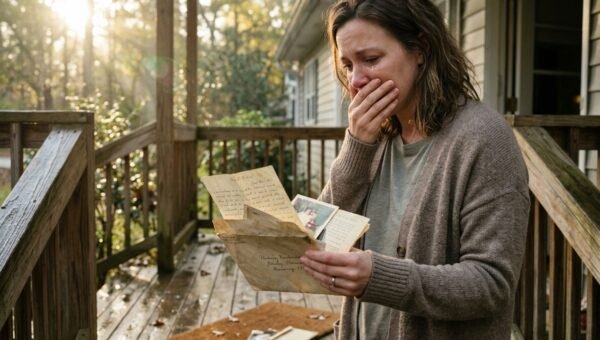
I opened the envelope with my name on it. The deed was folded inside, along with one more sheet of paper. Jesse had written me a letter.
He didn’t write much. He never was one to fill a page just to fill it.
“I’m sorry I went quiet,” he wrote. “I knew you’d try to fix this.”
I had to stop there. I read the line again.
“I couldn’t let you go broke trying to fix an engine that was already thrown.”
That was how he put it. His heart as an engine that couldn’t be repaired. It was such a Jesse way to say something awful. He’d spent his life fixing engines, and he knew the difference between a bad part and a thing you couldn’t save.
He wrote that he didn’t want me selling my house or using our family’s savings on him. He didn’t want me sitting in hospital hallways watching him get weaker. He knew I would do it anyway, and that was why he didn’t tell me.
He said the land mattered to both of us. He wanted me to have it without a lien or a bill attached. He said he was sorry I’d probably be mad.
I was mad. I was sorry. I was sitting there with his handwriting in my hand, and none of those feelings canceled out the others.
Near the end, he wrote, “Take the woods. Hunt opening morning for both of us.”
I read that line several times.
The thing is, I knew Jesse loved me. I’d known it as a kid when he waited for me to catch up on the trail. I knew it when he split his breakfast with me, even when he claimed he wasn’t hungry. But I’d decided his silence meant he didn’t want me around. It had been easier to believe I’d done something wrong than to face how helpless I would have felt if he’d told me the truth.
That wasn’t fair to him, or to me.
Still, he could have called. He could have let me sit beside him in a clinic. He could have let me be his brother instead of making up my mind for me.
I said that out loud, though there was nobody there to hear it.
“You could’ve called, Jesse.”
Then I said it again, quieter.
“You could’ve called.”
I didn’t tear up the letter or throw anything. I folded it back the way it had been and put it in the envelope with the deed. That was all I could manage right then.
The next morning I went through the remaining papers. The bills were his, and there wasn’t enough in the estate to pay them. I called the number on one notice and asked what I needed to do. They explained the basic steps. There wasn’t a house to sell or money tucked away. There wasn’t some big mess hidden behind the locked cabinet, either.
I swept the rental, wiped the kitchen counters, and carried the last box out to the truck. Mr. Henderson came back for the key. He looked around once and nodded.
“You did right by him,” he said.
I wanted to tell him I’d spent five years doing wrong by Jesse in my own head. I didn’t. I handed over the key.
The cap was still hanging by the door. I took it down and brushed the dust off with my sleeve. It smelled a little like the closet, a little like old fabric. The VFW patch was worn at the corners.
The compass was still in the cabinet, next to the hunting log. I picked it up and closed the leather case. Dad had carried it when he was alive, then Jesse kept it. I’d never asked for it. I didn’t know Jesse had held on to it all this time.
I put the log, the compass, and the receipts in the cab instead of the truck bed. The rest of Jesse’s things were packed under a tarp. His whole life still fit back there, though now I knew the part that mattered most hadn’t been sitting out in the open.
The cabinet stayed behind, empty except for the bolt cutters lying at its feet. I shut the doors, though there was no lock left to close.
I drove home with the letter in the glove box and the deed on the seat beside me. At a red light, I reached over and touched the envelope. I didn’t open it again. I knew what it said.
I kept the land. I still hunt there. Opening morning came, and I went alone, because Jesse had asked me to. I stood by the old stand and listened to the woods wake up. I didn’t pretend he was beside me. I just let myself remember him without asking what I’d done wrong.
Later, at the edge of the Sapulpa driveway, I sat on the tailgate before heading home. I placed Jesse’s faded VFW cap on the passenger seat beside our father’s brass compass. Then I got in, started the F-150, and drove away with the cab full of what he’d kept for me.