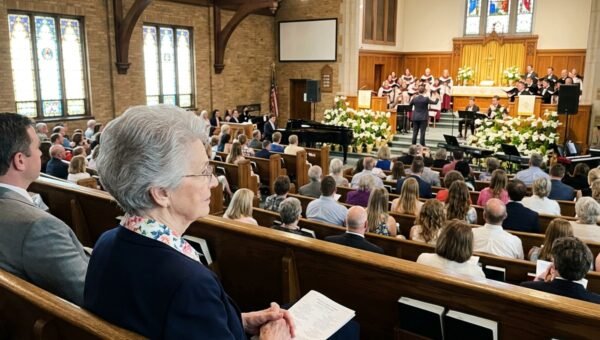
Mama left my sister the house and me her blue church hat. “Figures,” Darlene said after the funeral, standing by the gravel path while the cemetery crew waited to pull their tarps over the grass. “You always liked junk.” The house sold for $365,000 in eight days flat, because Darlene didn’t waste any time clearing out forty years of memories to cash out her inheritance. I took the hat home because it smelled like White Rain hairspray, that familiar drugstore scent that always meant Sunday morning breakfast was coming.
For two months, I let it sit on my dresser in the back bedroom, a little blue wreath of straw and faded silk flowers that didn’t match anything else I owned. Then the brim split while I was dusting it on a rainy Tuesday morning, and a folded bank card slid out, wrapped tightly in a church choir program paper. I gripped the wooden edge of the dresser because my knees felt sudden and hollow. The card was for a credit union account registered in Mama’s maiden name, Evelyn Vance, and the balance receipt tucked behind it showed eighty-two thousand six hundred dollars. On the back of the program, written in Mama’s neat, trembling hand, she had left a final instruction: If Darlene got the house, open Psalm 27 in my red Bible and look for the…
That was all she wrote. Just those few words, hanging there like an unfinished sentence that left my heart pounding against my ribs.
I sat down right on the edge of the bed with the plastic card in my palm, feeling the cool air from the open window hit the back of my neck. Darlene had been so sure she had outsmarted everyone, gloating about how she managed the probate filing before the flowers on Mama’s grave had even started to brown. Darlene was the older sister who always treated my quiet life like a failure, reminding me at every family dinner that I hadn’t married a man with a pension or bought a split-level with a two-car garage. When Mama had that minor stroke three years ago, Darlene was the one who drove her to the lawyer’s office to sign the deed transfer over, claiming it was just to protect the property from Medicaid liens if Mama ever needed nursing home care. I remembered Mama sitting on her floral sofa afterward, staring out at the hydrangeas with a look in her eyes that wasn’t fear, but something much colder.
Mama had always been a quiet woman, a church secretary who kept her ledger books balanced down to the penny and never raised her voice above a pleasant murmur, but she saw right through people. Darlene thought she had pulled off a masterstroke by taking the house, but she had completely underestimated the woman who raised us.
I walked into the living room and reached for the top shelf of the bookcase where Mama’s red leather Bible sat between a dictionary and a collection of local church histories. The gold lettering on the spine had worn away decades ago, but the leather was soft from being held through thousands of Sunday sermons and late-night worries. I carried it back to the kitchen table, spreading out the choir program and the credit union card next to a cold cup of coffee. When I opened the cover, the pages fell naturally toward the middle, held apart by a ribbon that had been moved thousands of times.
I turned the thin, onion-skin pages until I reached Psalm 27, the chapter Mama had underlined so heavily in pencil that the graphite had torn a tiny hole through the paper. Verse one stared up at me: The Lord is my light and my salvation; whom shall I fear? I ran my thumb down the column of text, past verse ten, where Mama had written a small notation in the margin. Tucked right into the binding behind verse twelve was a small, brass safe-deposit key taped to a folded strip of cardstock, and right beside it was a carbon copy of a legal document bearing the signature of Mr. Eugene Hollis, our family attorney and the senior deacon at Grace Baptist.
The note on the cardstock wasn’t long, but it explained everything with the kind of clinical precision Mama was famous for when she was running the church bazaar. It said that the credit union account was funded through a series of separate certificate deposits Mama had made over the last twenty years, using her own private inheritance from our grandfather Vance and the modest royalties from the timber lease on our uncle’s old woodlot. Darlene had never known about that land because it was registered three counties over, and Mama had kept the paperwork locked in a filing cabinet that Darlene never bothered to look through. Mama wrote that she knew Darlene would pressure her into signing over the deed to the family home, and rather than fighting a bitter court battle that would have broken her heart completely, she simply let Darlene have what she wanted on paper. Mama told me in the letter that she wanted me to have something that Darlene couldn’t touch, couldn’t tax, and couldn’t sell out from underneath me in eight days.
I sat there at the table for a long time, reading those lines over and over, feeling a strange mix of grief and vindication washing away the ache of feeling forgotten at the funeral. Mama hadn’t forgotten me at all; she had been protecting me from the grave using the very hat Darlene had dismissed as worthless junk.
The next morning, I took the brass key and the credit union card down to the First Mutual Credit Union off Main Street, where the teller, a kind woman named Brenda who had known Mama since I was six years old, looked at the account number and nodded without a single flicker of surprise. Mr. Hollis was already waiting in a small glass-walled office near the back, looking distinguished in his gray seersucker suit with his Bible tucked under his arm. He invited me in, closed the frosted glass door, and slid a manila folder across the mahogany desk that contained the official Payable on Death beneficiary forms and the certified letter of release. He told me that Mama had come into his office two years ago, right after Darlene had started pushing her about the house deed, and had set up the account with explicit instructions that it was to be handed directly to me the moment she passed away.
Mr. Hollis looked at me over his wire-rimmed glasses and said that your mother was a remarkable woman who knew human nature better than most judges he had practiced in front of for forty years. I signed the transfer papers, and within twenty minutes, the eighty-two thousand six hundred dollars was moved into a clean account bearing my own name, completely free of probate, liens, or family claims.
I thought that would be the end of it, that I would go home, put the money into a high-yield savings certificate, and finally buy that little cottage with the wraparound porch down on Elm Street. But karma doesn’t move that slowly in a town where everybody’s business is settled over Sunday potluck. Three days after I left the credit union, my phone rang while I was standing at the kitchen sink peeling potatoes for supper. The caller ID showed Darlene’s cell phone number, and her name flashed across the screen with a ringtone I hadn’t updated in ten years. I let it ring out to voicemail, watching the little red notification dot blink twice before it stopped. A minute later, a text message came through, and then another, each one more frantic than the last. The first text said I needed to call her immediately because there was a serious problem with the estate filing. The second text said the title company was holding up the closing money because of some old lien Mama had placed on the property back in nineteen-ninety-eight. I dried my hands on a dish towel, walked over to the armchair by the window, and finally pressed the green button.
Darlene didn’t even say hello, which was typical of how she always opened our conversations when she needed something fixed. “Where have you been?” she demanded, her voice tight and breathless like she had been running across a parking lot in high heels. “I’ve been trying to reach you since noon. The title company just called my broker and said there’s an unreleased life estate encumbrance on the Maple Street house that has my entire $365,000 escrow check frozen solid.” I listened to the sound of heavy traffic in the background, picturing her sitting in her leased SUV outside some downtown title office looking like her world was caving in. I didn’t say anything for a second, and honestly that felt worse than shouting because she hated being ignored more than anything else in the world. “Are you even listening to me?” Darlene snapped, her voice rising an octave above its usual demanding register. “The closing agent says the original owner of record never filed a proper quitclaim release when the deed was transferred three years ago, and since Mama passed away without clearing it, they need a signature from the secondary beneficiary to release the funds. That’s you. You have to sign the release form today so I can get my money.”
I leaned back against the cushion, feeling the afternoon sun warm through the glass pane, and thought about the blue church hat sitting on my dresser upstairs with its neatly mended brim. “Well, Darlene,” I said, keeping my voice entirely flat and level. “That’s a real shame about your closing check. It sounds like someone should have checked the title work before they sold a house that didn’t fully belong to them.” There was a sharp intake of breath on the other end of the line, followed by a long, heavy silence that stretched out for several seconds. “Don’t play games with me,” Darlene hissed, her tone dropping into that cold, threatening register she used whenever she didn’t get her immediate way. “You’re my sister. You sign whatever paper they put in front of you so I can get my money out of escrow, or I swear to God I’ll make sure you never see another dime from this family.” I let out a quiet breath, smiling to myself because she still didn’t understand that she had zero leverage left. “I’m not signing anything today, Darlene,” I told her plainly. “I’m busy.
Besides, you told me yourself at the cemetery that I only like junk. You take care of your own house problems.” Before she could scream another word into the receiver, I hit the red button and ended the call, cutting her off right in the middle of a sentence about lawyers and court orders.
The next two weeks were remarkably quiet, the kind of quiet that feels like a heavy blanket settling over a room after a long storm. Darlene tried everything she could think of to break my resolve, sending certified letters from a local real estate attorney threatening me with breach of contract and demanding an emergency meeting at his office on Fourth Street. I simply took those letters down to Mr. Hollis, who read them, laughed softly into his coffee cup, and sent a single official response back stating that my rights as the primary beneficiary of Mama’s estate were entirely secure and that any encumbrance on the Maple Street property was a matter for Darlene and her title insurance company to resolve through proper legal channels. It turned out that the lien Mama had placed on the house before signing the deed over to Darlene was completely airtight, a legal safeguard Mama had engineered with Mr. Hollis to ensure that the property couldn’t be sold off quickly without settling certain family obligations first.
Darlene ended up having to wait ninety full days through a mandatory escrow audit, paying thousands of dollars in monthly carrying costs, bridge loan interest, and legal fees just to get the title cleared so she could access the remainder of her sale proceeds. By the time she finally gave up and agreed to terms that Mr. Hollis and I set down, she had lost nearly fifty thousand dollars of her fast-cash windfall to penalties and administrative costs.
I didn’t gloat, and I didn’t go to her closing to watch her sign the final paperwork, because Mama had taught us that true dignity doesn’t require an audience. Instead, I used my eighty-two thousand six hundred dollars to buy a small, single-story cottage down on Elm Street with a lovely bay window that looks out over a row of blooming rose bushes. It didn’t cost $365,000, and it didn’t have a double garage or granite countertops, but it was mine from the foundation to the shingles, paid for in full with a cashier’s check that didn’t need a single signature from Darlene Vance. I spent my first Saturday in the new house unpacking my kitchen boxes and setting up the small things that actually mattered to me. When the afternoon sun started to dip low behind the oak trees in the front yard, I brought the blue church hat down from the upstairs bedroom and placed it carefully on an antique mahogany stand in the sunlit parlor.
The delicate split in the straw brim had been mended with a neat, nearly invisible navy-blue silk thread that I sewed myself while sitting on the front porch. It still smelled faintly of White Rain hairspray if you leaned in close enough, a comforting, familiar reminder of a woman who didn’t need to shout to win her battles. Darlene hasn’t called me since the escrow finally cleared, and I haven’t reached out to her either, because some distances are just too wide to cross with a phone call. I walked over to the stand, adjusted the brim so it caught the last warm rays of daylight through the bay window, and stood there quietly in the peace Mama had left behind for me.